Building a Mobile Product from a Legacy Platform
ePRO (Electronic Patient Reported Outcomes) data records how a drug or device actually affects the people taking it, which makes it central to every clinical trial. Our EDC could no longer support that work well, so I designed and shipped DribbleCollect: a 21 CFR Part 11 compliant ePRO patients can download from the app store.
ClearQ was an established EDC for running clinical trials, and it was steadily losing clients. The interface fought the people using it, and the architecture had no room left to grow. I owned both the product and the design, so I could not treat those as separate problems. A brittle experience produced bad data, and a rigid back-end made the experience impossible to fix without a rebuild.
Two failures compounded each other, in exactly the place a clinical trial can least afford it: the data itself.
An interface working against its users
Error rates and drop-offs were high, and the instructions were hard to follow. Every point of friction was another chance to lose reliable data.
A back-end with no room to move
Limited scalability, no independent operation, and no API. The platform could not integrate with other systems or grow alongside the trials it supported.
Meet DribbleCollect
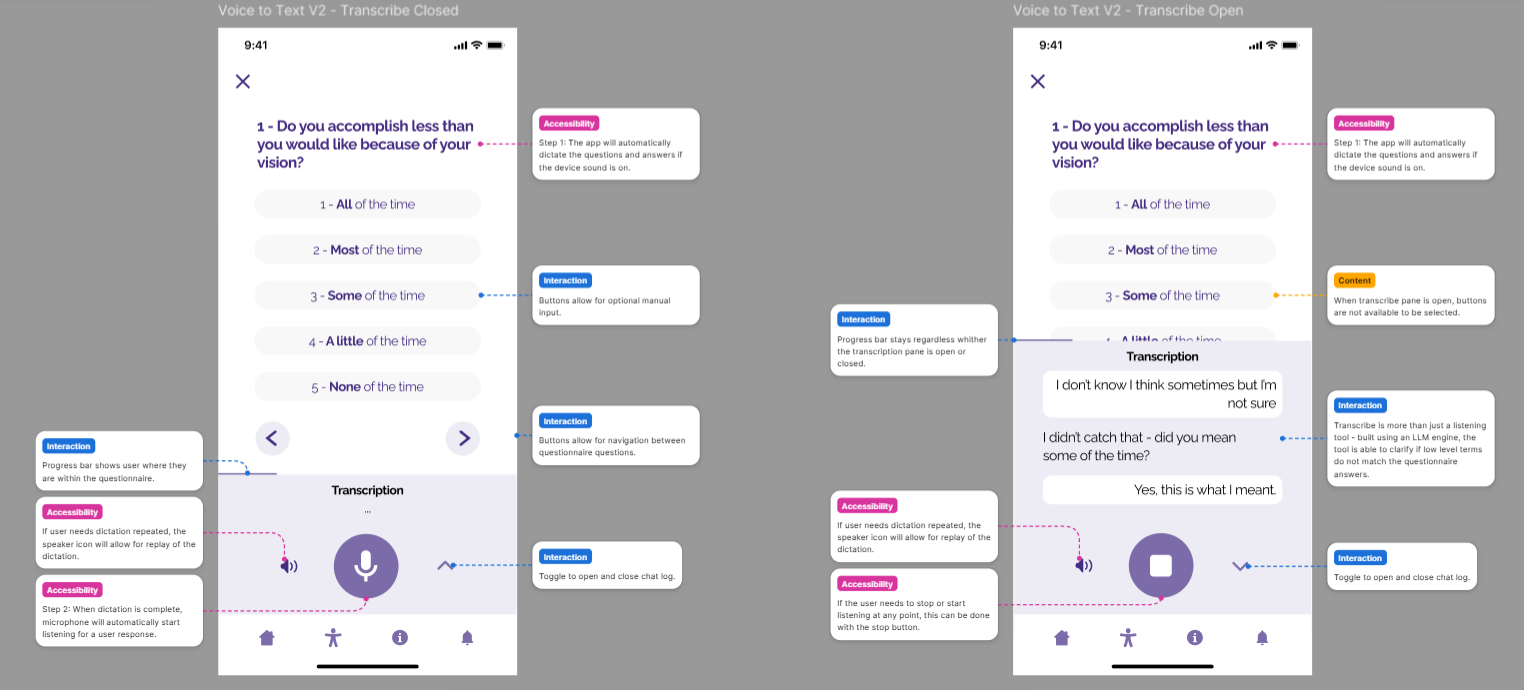
DribbleCollect answered both failures at once: a rebuilt experience on a rebuilt foundation. The prototype below is the real flow, from secure login through voice-to-text capture. Move through it the way a patient would.
- AI voice-to-text data entry, built 21 CFR Part 11 compliant
- A 3-step login and reporting flow that cut task time
- A modular back-end that runs independently, with its own API
- An accessible UI, localized for multinational trials
- 01
Onboarding & secure login
Weighed Okta 2FA and Google Authenticator to earn trust at the first step, then simplified the path down to a 3-step login and reporting flow.
- 02
Voice-to-text capture
Tested Siri, ChatGPT, and Amazon Transcribe Medical against usability and cost. Siri won for this audience and became the core of natural-language entry.
- 03
Autosave, progress & sync
Built a sync process that saved data accurately and showed users their progress, resolving longstanding fears about lost entries.
- 04
Accessibility & onboarding support
Iterated the UI against WCAG 2.1 AA and added an introductory video, so low-tech-literacy patients felt at ease from day one.
Four voices, one fragile chain of data
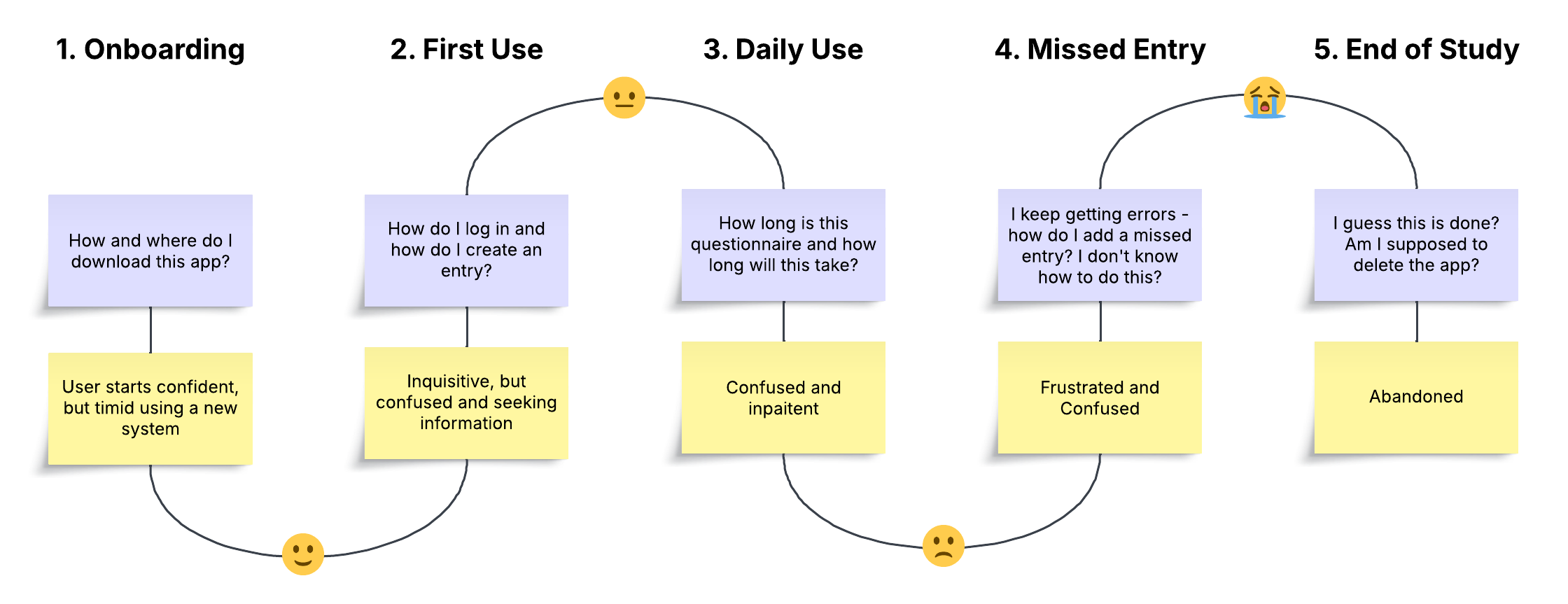
Questionnaires, interviews, and usability testing surfaced three voices in the same fragile chain of data. Mapping the legacy experience made the stakes undeniable.
Patients abandon tools that waste their time
Each questionnaire meant stopping to give ten minutes of undivided attention by hand. When it felt invasive, patients simply stopped responding.
Site staff need to spend time on care, not tech support
Staff burned hours troubleshooting errors for patients who could not get the tool to work, time taken directly from patient care.
Data has to be reliable the first time
Data managers wrestled with lost, incomplete, and non-compliant entries. Capture had to be near-effortless without sacrificing accuracy.
Every objective, delivered
Compliant by design
- Built audit trails, time-stamped entries, and e-signature validation into the workflow
- Ran mock FDA inspections during QA to prove 21 CFR Part 11 compliance before any client release
Usable & inclusive
- Cut average task time 40% with a 3-step flow, validated with low-tech-literacy patients
- Applied WCAG 2.1 AA and localized into English, French, and Spanish for multinational trials
Built to scale
- Shipped a microservices back-end with real-time API connections to major EDC systems
- Added a questionnaire builder so sponsors could stand up a new PRO module in under 24 hours
Shipped to one dedicated client to confirm the need was real. Since the need came from a direct client request, this stage felt redundant, a candid lesson that skipping it could have saved time.
Feedback loopIn-flow micro-surveys and a report-a-bug option
Widened to three clients across therapeutic areas. This is where the product got resilient: it uncovered edge cases we had not anticipated.
Feedback loopTagged micro-surveys, an embedded widget, and user-panel testing
Launched publicly at 80% client satisfaction, with continuous monitoring so we could respond to real usage quickly.
Feedback loopRandomized thumbs-up / thumbs-down ratings on every rollout
On a project this complex, clear communication mattered more than I expected. Small misreadings were expensive to fix later.
Prioritization and trade-offs were not optional. They were how the team actually met the deadline.
Designing for accessibility from the start made the product better for everyone, not only for users with disabilities.